
Why posting time can affect early engagement
Posting time matters because Instagram content often receives its first signals soon after publishing. If your followers are active when a Reel, carousel, Story or photo goes live, they are more likely to see it, watch it, save it, share it, comment or visit your profile. These early responses can help you understand whether the content matched audience interest. Timing is especially useful for accounts that already have some followers and want to publish when those followers are awake, online and likely to pay attention.
If a public post campaign is part of your plan, check Instagram likes ordering requirements and measure reach, saves and enquiries separately from the like count.
- 01Set the goal
- 02Choose the format
- 03Review details
- 04Track progress
Practical actions
- Treat timing as a visibility helper, not a guaranteed growth button.
- Compare posting time with reach, saves, shares, comments and profile visits.
- Do not judge a time slot from one post only.
Content quality still matters more than timing alone
A good posting time cannot fix a weak hook, confusing visual, poor caption or irrelevant topic. If the content does not help, entertain, inspire or inform the right audience, posting at a popular time may only show the weak post to more people. The strongest Instagram strategy combines audience-fit content with a sensible publishing schedule. For example, a helpful carousel posted at a reasonable time can earn saves for days, while a rushed promotional post may fade quickly even if published during an active window.
Practical actions
- Improve the post idea before obsessing over the hour.
- Use timing tests only after your content pillars are reasonably clear.
- Measure quality through saves, shares, watch time, replies and profile actions.
How Indian Standard Time affects scheduling
Most Indian audiences follow Indian Standard Time, but their active hours still differ. Students, office workers, founders, parents, freelancers and local shoppers have different routines. If your audience is mainly in India, plan your first tests in IST. If you serve global audiences from India, you may need a second schedule for the countries that matter most. A creator in Mumbai targeting Indian college students will not use the same publishing rhythm as a B2B consultant in Bengaluru targeting founders in India, the UAE and the UK.
Practical actions
- Use IST as your base if most followers live in India.
- Check top cities and countries inside Instagram Insights.
- Create separate test windows if a large part of your audience is international.
How to check Instagram Insights
Instagram Insights should be your primary source for posting-time decisions. Open your professional account, go to Insights, review Total followers, and check audience activity by days and hours. Then compare those active periods with performance on your posts, Reels and Stories. Look beyond likes. A useful time slot may produce more saves, shares, comments, profile visits or website taps depending on your goal. If your account is new and Insights are limited, start with broad Indian testing windows and collect your own data for 30 days.
Practical actions
- Check active days and active hours before planning the week.
- Record the published time, format, topic and result for each post.
- Use account-specific data over generic advice whenever possible.
Finding active days and active hours
Active days show which weekdays your followers are most likely to open Instagram. Active hours show when they are usually online on those days. A local restaurant may see stronger activity before lunch or dinner decisions. A personal finance creator may see stronger attention after work. A student-focused education page may perform better before classes, after college or later in the evening. The point is to match the post with the moment when your audience is most ready for that content type.
Practical actions
- Separate weekday and weekend patterns instead of averaging everything.
- Match educational posts with focused time and entertainment posts with relaxed time.
- Watch whether the same time works across several formats or only one format.
Starting test windows for Indian audiences
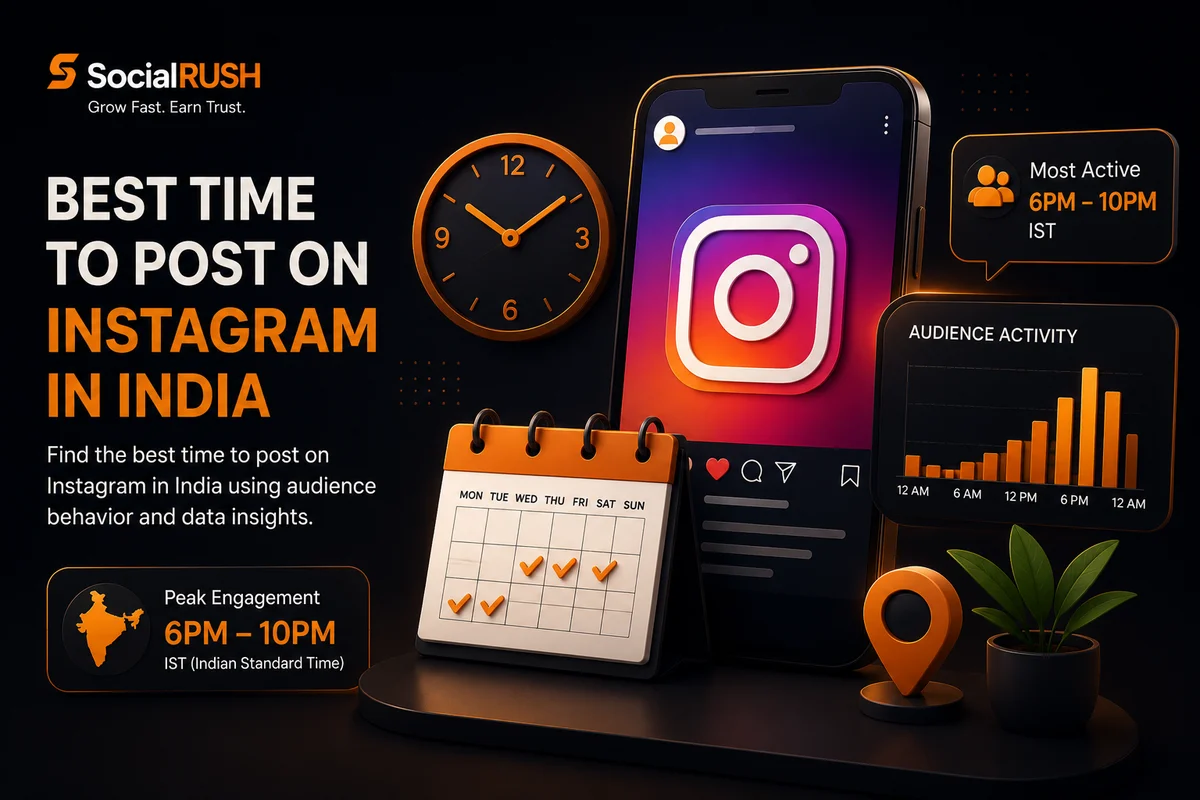
If you do not have enough account data yet, use simple IST windows as starting points. Morning posts between 7:00 AM and 9:00 AM can catch people before school, college or work. Afternoon posts between 12:00 PM and 2:00 PM can reach people during breaks. Evening posts between 6:00 PM and 9:00 PM can reach audiences after work, classes or daily responsibilities. These windows are not universal best times. They are only starting points for your own experiment.
Practical actions
- Test each window with similar-quality content before comparing results.
- Avoid declaring a winner after one Reel or one carousel.
- Use your own Insights to refine or replace these windows.
Morning, afternoon and evening posting behaviour
Morning audiences may prefer quick, useful or motivational content. Afternoon audiences may respond to short practical posts, updates or bite-sized education. Evening audiences often have more time for Reels, carousels, longer captions and community conversation. But behaviour changes by niche. A fitness coach, clothing store, local cafe, education creator and B2B consultant should all test rather than copy the same schedule.
Practical actions
- Use morning for quick ideas, reminders or start-the-day value.
- Use afternoon for practical posts that fit a break.
- Use evening for content that may need more attention or discussion.
Weekday versus weekend posting
Weekdays often follow work, study and commute patterns. Weekends can be more flexible but also less predictable because people travel, attend events, spend time with family or shop offline. For some businesses, weekends are powerful because customers are free to browse. For professional content, weekdays may perform better because the audience is in a work mindset. Compare days in your Insights before assuming weekends are always better or worse.
Practical actions
- Test important educational or professional posts on weekdays.
- Test lifestyle, entertainment, shopping or local content on weekends.
- Watch festival weekends separately because behaviour may change.
Posting for students, professionals and business owners
Students may be active before classes, during breaks and later in the evening. Working professionals may check Instagram before work, at lunch or after office hours. Business owners may scroll early, late or between customer tasks. A personal brand should think about when its ideal audience has attention, not only when they are technically online. A post that needs decision-making may work better when the audience is relaxed enough to read.
Practical actions
- For students, test morning, late afternoon and evening windows.
- For professionals, test lunch breaks and after-work periods.
- For business owners, test early morning and evening but verify with Insights.
Posting for local, national and international audiences
Local businesses should schedule around local customer behaviour. A salon, gym, tutor, cafe or clinic in India may care about nearby people more than national reach. National brands should test broader IST windows that work across Indian cities. Accounts targeting international audiences from India need to consider time zones. If your audience is split between India and another country, alternate test slots instead of forcing every post into one Indian window.
Practical actions
- Local brands should connect posting time with buying or enquiry moments.
- National pages should compare performance across Indian cities.
- International pages should check top countries before finalizing schedule.
Best testing times for Reels, carousels, photos and Stories
Different formats behave differently. Reels can continue reaching new viewers after publishing, but early watch behaviour still matters. Carousels often depend on saves and shares, so they may work when people have time to read. Photo posts can perform well when the visual is strong and the audience is active. Stories are more immediate and can be posted throughout the day, especially around moments your audience cares about. Test each format separately because one schedule may not fit all.
Practical actions
- Test Reels in morning and evening windows first, then refine by watch behaviour.
- Test carousels when followers have time to read and save.
- Use Stories throughout the day for quick updates, polls and reminders.
How frequently to post
Frequency should support quality. Posting daily with weak content can hurt interest, while posting rarely can make the account feel inactive. Many creators and businesses can start with three to five feed posts or Reels per week plus regular Stories, but the right number depends on capacity and niche. It is better to publish consistently for 30 days than to publish heavily for one week and disappear for the next three.
Practical actions
- Choose a schedule you can maintain without rushing posts.
- Use a mix of Reels, carousels, photos and Stories when relevant.
- Increase frequency only if quality and engagement remain steady.
How long to test a posting schedule
A posting-time test needs enough data to be useful. Test a schedule for at least a few weeks before making a decision. Compare similar formats and similar topics where possible. A funny Reel and a serious carousel cannot fairly judge the same time slot. Keep a simple tracker with the date, time, format, topic, reach, saves, shares, comments, profile visits and follows. Patterns become clearer when you stop relying on memory.
Practical actions
- Run a 30-day test before changing the schedule completely.
- Compare content types separately.
- Review results weekly and adjust gradually.
Why one successful time may not work for every post
A post can perform well because of the topic, hook, visual, caption, trend, audience mood, format or timing. If one Reel works at 8:00 PM, that does not mean every future post should go live at 8:00 PM. Timing is one variable. Keep testing, but avoid turning one success into a permanent rule. The best schedule is flexible enough to learn from new data.
Practical actions
- Look for repeated patterns, not isolated wins.
- Separate topic performance from time performance.
- Review your schedule monthly as the audience grows.
Festivals, holidays and major events can change activity
Indian audience behaviour changes during festivals, holidays, exams, cricket matches, sales seasons, local events and long weekends. A normal posting time may underperform if the audience is offline, travelling or focused elsewhere. On the other hand, festival-related content can perform well if it is relevant and timely. Plan flexible calendars around important events instead of forcing the same schedule every week of the year.
Practical actions
- Mark festivals and major events before planning content.
- Post event-related content early enough for people to act on it.
- Avoid judging your normal schedule from unusual holiday behaviour.
How to schedule Instagram content
Scheduling helps you stay consistent even when you are busy. Plan content ideas weekly, create captions in batches, prepare visuals, and schedule posts through approved tools or Meta's planning features where available. Leave space for real-time Stories and trend-based content. A schedule should reduce stress, not make the account robotic. Review comments and replies after publishing so the community still feels active.
Practical actions
- Batch captions, creatives and hashtags before the week starts.
- Keep room for timely posts and Stories.
- Check the post after publishing to reply to early comments.
Weekly sample posting calendar
A sample week for an Indian Instagram account might include a Monday morning educational Reel, a Tuesday evening carousel, a Wednesday Story Q&A, a Thursday afternoon photo or product post, a Friday evening Reel, and weekend Stories around behind-the-scenes or community moments. This is not a fixed template. It is a starting structure. Replace formats and times based on your niche, available content and Insights.
Practical actions
- Monday 8:00 AM: useful Reel or quick tip.
- Tuesday 7:30 PM: carousel with practical advice.
- Thursday 1:00 PM: product, service or behind-the-scenes post.
- Friday 8:00 PM: Reel or community-focused content.
A practical 30-day timing experiment
For 30 days, test three windows: morning, afternoon and evening. In week one, publish similar-quality posts across all three windows. In week two, repeat the test with a different format. In week three, focus on the two windows that showed stronger reach and engagement. In week four, refine by active days and content type. At the end, choose a schedule based on your own data, not generic advice.
Practical actions
- Track time, day, format, topic, reach, saves, shares, comments, profile visits and follows.
- Avoid changing too many variables in the same week.
- Use the final week to confirm patterns before committing.
Common posting-time mistakes
Common mistakes include copying another creator's schedule, ignoring Instagram Insights, posting only when you personally are free, changing time after every weak post, assuming timing matters more than content, ignoring weekends or holidays, and judging every format with the same rules. Another mistake is posting at an active time but disappearing from comments. Early conversation can matter for community, so stay available after important posts when possible.
Practical actions
- Do not copy a schedule without checking your own audience data.
- Do not change the entire plan after one underperforming post.
- Do not ignore post-publishing engagement and replies.
Conclusion
The best time to post on Instagram in India depends on your audience, content format, niche and Insights data. Morning, afternoon and evening windows can help you begin testing, but they are not guaranteed best times for every account. Start with sensible IST windows, track real metrics for 30 days, and refine your schedule around audience behaviour. Most importantly, keep improving content quality, relevance and consistency because timing only works when the post itself gives people a reason to care.
Practical actions
- Use generic time windows only as starting points.
- Let Instagram Insights guide the final schedule.
- Build a posting rhythm that supports both quality and consistency.